Historical Background: From Hills of Helambu to the Growing Communities of HELP
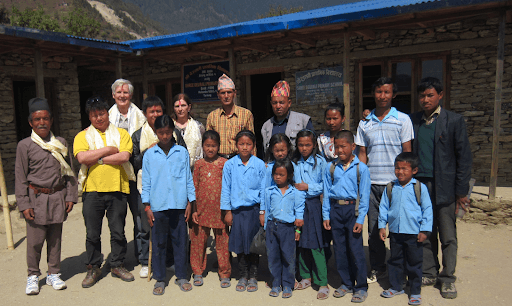
HELP was born not from outsiders' desire to intervene, nor from projects shaped by funding privilege or boardroom decisions. It emerged from the heart of the hills—from the lived experiences of a group of friends who were deeply shaped by the villages that raised them.
In early 2009, after Nepal emerged from a decade-long political conflict through a comprehensive peace process, hope for a better future began to rise. Against this backdrop, a group of young people from Helambu, led by our founder Jimmy Lama, began reconnecting with their home communities in Sindhupalchowk.
What they witnessed was deeply troubling. Communities that once gave them wings were now struggling—crumbling classrooms, absent teachers, missing desks, and increasing student dropouts. Children were not lacking potential; they were lacking opportunity. This reality demanded a strong sense of responsibility and action.
With a grassroots perspective and a vision to accelerate opportunity through education, the group carried out a village-to-village needs assessment. Their findings were clear: if basic infrastructure could be restored—desks, books, clean drinking water—education could thrive.
During this early phase, HELP's commitment was strengthened by the vision of Anthony Lunch and the Mondo Foundation. Their support made it possible to transform informal efforts into a formal organization. Thus, HELP (Helambu Education and Livelihood Partnership) was born, now proudly in its 16th year of operation.
Surveying the Initial Needs
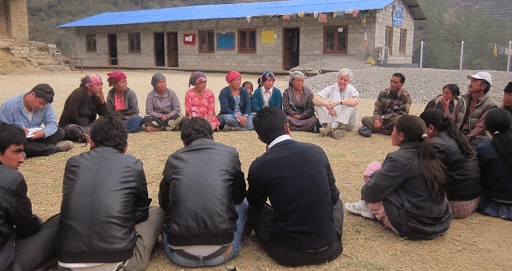
After returning from the UK following his work with the Mondo Foundation, Jimmy Lama, along with his school friends Chiring and Nima Tshering, conducted a needs assessment in June–July 2009.
Their journey began in Ichowk and continued through Tartong, Nakote, Timbu, Nurbuling, and Dhudeni. With no motorable roads at the time, the assessment required a week-long trek across the hills of Helambu.
They met with school headmasters, management committees, and local villagers to understand the challenges facing education in these communities.
- Severe overcrowding due to a lack of classrooms and teachers, with 35–40 children often sharing a single room.
- Low attendance among girls, particularly in Tamang communities, where daughters were often sent away for domestic work.
- Minimal access to learning resources such as books, music, sports, or extracurricular activities.
- Poor teacher training and outdated curricula that failed to meet students needs.
These findings led HELP and Mondo to take immediate action, supporting the first six schools.
Our Evolution: Foundational Years (2009–2015)
HELP's journey officially began in 2009 with the formation of a committed local team and strong community ties. From the start, HELP's focus was off-the-beaten-track; working in places where few organizations reached, with a clear mission: to connect education opportunities and resources to the rural schools that needed them most.
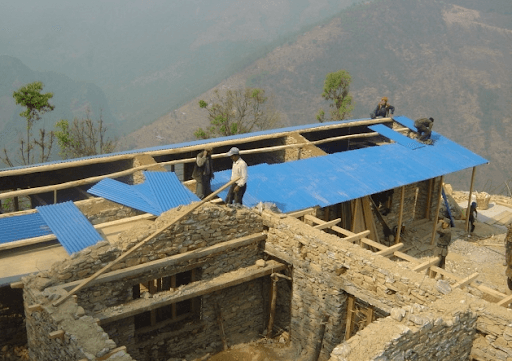
The Basic School Infrastructure Support (BaSIS) programme (2010–2011) marked HELP's first organized initiative, targeting 10 public schools in Helambu. It provided classroom construction, benches and desks, toilets, drinking water systems, ECD centers, and essential learning materials.
Rehabilitation and Reconstruction Period (2015–2019)
The earthquake of April 2015 changed everything. Over 90% of schools in Sindhupalchowk were destroyed, and entire communities were displaced. For HELP, this was not just a crisis- it was an existential challenge. Homes collapsed, and so did the very schools HELP had helped build. It was devastating. But in that moment of despair, HELP found renewed purpose.
The team mobilized emergency relief for over 3,000 families across 32 villages, delivering food, shelter, and medical aid. But most importantly, they set out to restore hope in education. Within weeks, HELP established 226 Temporary Learning Centers (TLCs) in 45 schools, ensuring that learning didn't stop, even when everything else had.
HELP soon emerged as a key player in the education recovery effort. In close collaboration with the District Education Office and the National Reconstruction Authority, HELP rebuilt over 100 earthquake-resistant classrooms in 15 schools, guided by collective goals: “Building Back Better.” It wasn't just about buildings. We trained 4-5 members from each community where we were going to build schools, who led the reconstruction process, cementing local ownership, skill-building, and resilience.
Conceptualisation and Launch of Saathi Teachers Programme (2019 – Ongoing)
By 2019, as schools were physically rebuilt, a critical question emerged: were children actually learning? The answer was clear—they were not.
Many students struggled with basic literacy and numeracy. A survey conducted in 2019 in PaanchPokhari Rural Municipality revealed alarming gaps in learning outcomes. 95.5% of students in Grades 3 to 5 were unable to add three four-digit numbers (e.g., 369 + 674), a competency expected by Grade 3. Similarly, 70.5% of Grade 3 students were unable to correctly use the articles a and an. Similarly, a survey conducted in Tripurasundari Rural Municipality shows that the proportion of students able to read at least one word increased from 34% in 2021 to 50% in 2025, following the introduction of support from the Saathi Teachers Programme. Beyond learning gaps, the classroom environment itself was a concern. A 2021 survey found that 72% of students had experienced some form of punitive teaching practices. However, within two years of the launch of the Saathi Teachers Programme, this figure was reduced significantly to 41%, demonstrating the impact of supportive, child-centred teaching approaches.
These findings highlighted the urgent need for stronger and more targeted interventions in early-grade education. In response, HELP launched the Saathi Teachers Programme, its flagship initiative designed to strengthen foundational literacy and numeracy. The programme places trained Saathi Teachers in public schools for a two-year teaching cycle. These teachers are recruited and trained to practice student-centred pedagogy, promote compassionate and non-punitive teaching, and work collaboratively with local teachers and school systems to build sustainable change.
Today, HELP continues to expand its impact through the deployment of 30 Saathi Teachers across 15 schools in three municipalities and two districts, providing daily academic support to more than 1,500 students and contributing to safer, more effective learning environments.